
What Is Attendance Allowance and Who Can Claim It
Attendance Allowance is a tax‑free, non‑means‑tested benefit for people of State Pension age in Great Britain who need help with personal care or supervision because of a disability or long‑term health condition. It is designed to help cover the extra costs that arise when you require someone to “attend” to you, whether that is a family member, friend or paid carer.
What Attendance Allowance is for
Attendance Allowance helps with the additional costs of care and support, not the care itself. You can spend the money on anything that helps you stay independent and safe, such as paying for extra heating, transport to medical appointments, adaptations at home, or contributions towards a carer’s time.
Because it is not means‑tested, your income, savings and capital do not affect eligibility or the amount you receive. It is also tax‑free and does not normally count as income for most other benefits, although it can affect some means‑tested benefits and local authority care charges.
Who can claim Attendance Allowance?
You may be able to claim Attendance Allowance if you meet all of the following core criteria:
You are State Pension age or over when you make your claim.
You have a physical disability, sensory impairment, mental health condition, learning difficulty or long‑term illness that means you need help with personal care or supervision for your own (or someone else’s) safety.
You have needed that help or supervision for at least six months, unless you are claiming under the “special rules” for terminal illness (where a medical professional has said you may have 12 months or less to live).
You are in Great Britain when you claim, have been here for at least two of the last three years (with some exceptions), are habitually resident in the UK/Ireland/Isle of Man/Channel Islands, and are not subject to immigration control (unless you are a sponsored immigrant).
You do not already receive Disability Living Allowance (DLA), Personal Independence Payment (PIP), Adult Disability Payment (ADP), Scottish Adult Disability Living Allowance, Pension Age Disability Payment or Armed Forces Independence Payment.
“Help with personal care” includes tasks such as getting dressed, eating and drinking, washing or bathing, using the toilet, getting in and out of bed, taking medication, and communicating needs. It also covers situations where tasks take you much longer, are painful, or you need physical support or supervision to stay safe.
Rates of Attendance Allowance
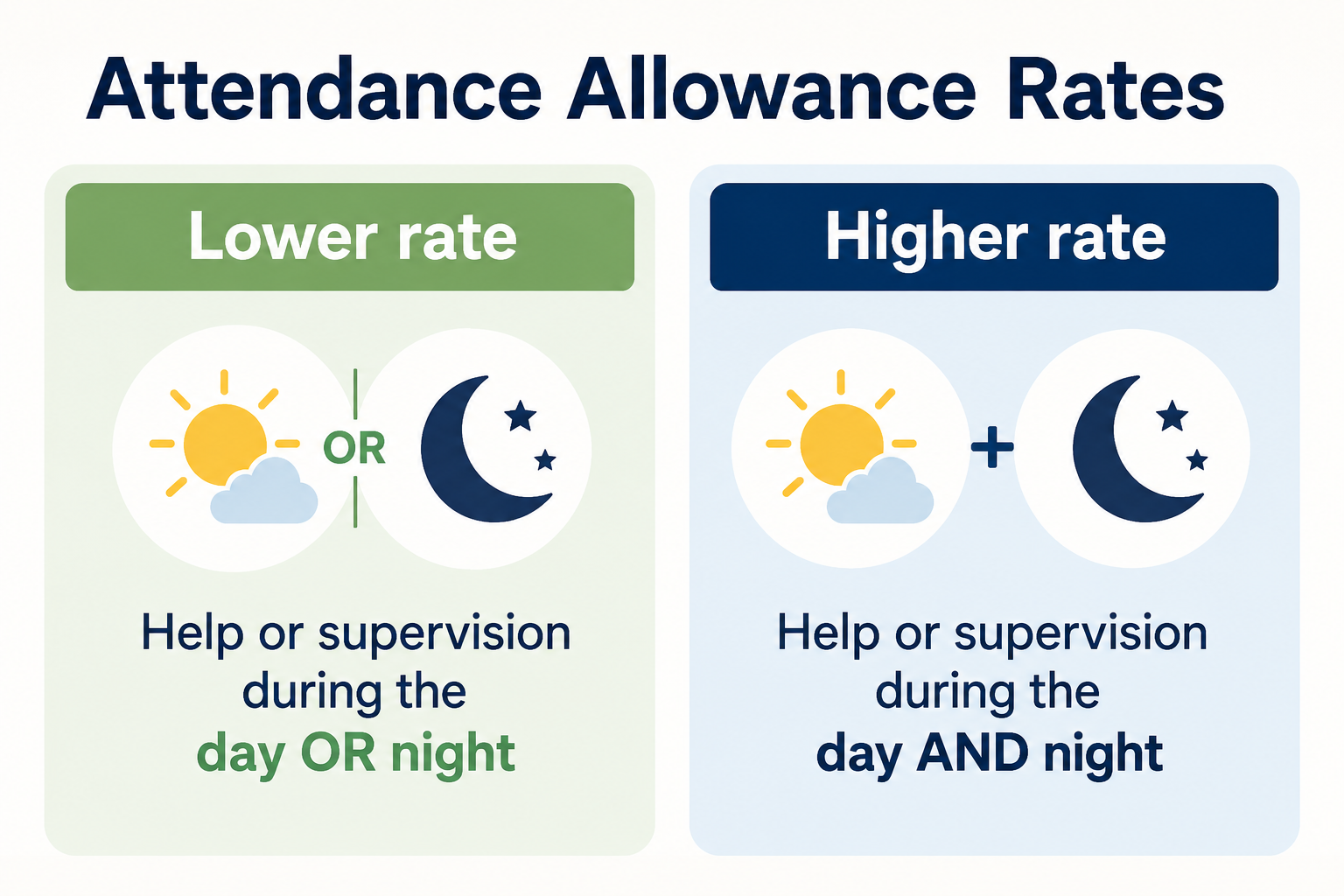
There are two weekly rates, depending on the level and timing of care or supervision you need:
Lower rate:
For people who need frequent help or constant supervision during the day, or supervision at night.
Higher rate:
For people who need help or supervision throughout both day and night, or who are terminally ill with a prognosis of 12 months or less to live.
Current rates are set by the government and are updated each April; check the latest figures on GOV.UK when you apply. (https://www.gov.uk/attendance-allowance/what-youll-get )
Why people use our Attendance Allowance application service
The Attendance Allowance form (AA1) asks detailed questions about your health, daily routine and care needs. Claims could be delayed or refused if the form does not clearly explain how a person’s conditions affect them day-to-day.
Our service is designed to reduce stress and improve the quality of your application. We:
Assess your situation against the eligibility rules and explain your likely entitlement.
Help you gather the right information, such as medication lists, GP details, hospital contacts and any supporting letters or care plans.gov
Work with you (and, if you wish, your family or carer) to describe your care needs clearly, including how often you need help, how long tasks take, and what happens on “bad days”.
Complete the AA1 form in a way that highlights the impact of your conditions and avoids common pitfalls, such as underdescribing needs or leaving sections blank.
You do not need to have someone already providing care to qualify; what matters is that your disability or health condition means you need that level of help or supervision.
How we can help you claim
If you think you or a relative may be eligible, contact us for an initial discussion about your circumstances. We can explain how Attendance Allowance works, what evidence is useful, and how our application support service can help you maximise your chances of a successful claim.
To speak to our team or request an Attendance Allowance application review, get in touch today.
Or call us on:
